Wireless window or door contact

The wireless window or door contact (transmitter) is used to control wireless receivers. The magnetic contact transmits the status of objects via wireless signals to a wireless receiver. If the window or door is opened or closed, an Easywave code is transmitted, and the connected, wireless receiver switches, depending on the set operating mode. A battery, mounting bracket with magnet, and a mounting set are included. In combination with the USB RF interface for Niko Home Control (410-00099), the wireless window or door contact can also be used in Niko Home Control installations.
Product details


Wireless Easywave window or door contact
The wireless Easywave window or door contact (transmitter) is used to control wireless Easywave receivers. The wireless Easywave window or door contact (transmitter) is a magnetic contact that transmits the status of objects via wireless signals to a wireless Easywave receiver. In combination with the Niko Home Control USB RF interface (410-00099), the wireless window or door contact can also be used in Niko Home Control installations.
If the window or door is opened or closed, an Easywave code is transmitted, and the connected, wireless Easywave receiver switches, depending on the set operating mode.
A battery, mounting bracket with magnet and a mounting set are included.
In combination with the Niko Home Control USB RF interface (410-00099), the wireless window or door contact can also be used in Niko Home Control installations.
- frequenty band: 868,0 – 868,6MHz
- maximum power output: -11,29 dBm
Specification description
Wireless Easywave window or door contact
- Not compatible with the wireless bridge, compatible with the wireless smart hub
- Communication protocol: Easywave
- Operating frequency: 0.8683 GHz
- Ambient temperature: -20 – +60 °C
- Protection degree: IP54
- Weight: 17 g
- Dimensions (HxWxD): 12.4 x 65.6 x 30.1 mm
- Marking: CE
Related products
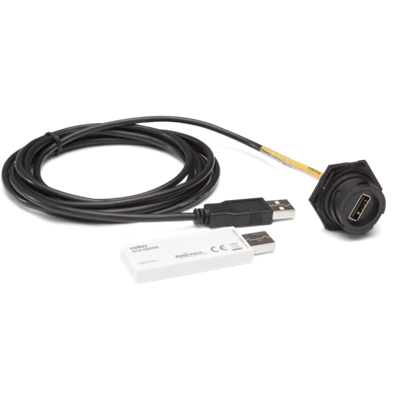
USB RF interface for Niko Home Control
The USB RF interface makes it possible to use Niko wireless Easywave controls (with the exception of the remote control 05-312) in the Niko Home Control installation for bus cabling. This allows wireless controls to be installed: • on surfaces unsuited to cabling (e.g. glass or concrete partitions) • for the renovation of heritage-listed buildings • for expansions of existing installations where drilling or channelling work is not permitted • in office areas with movable partition walls • when complex cabling is to be avoided. The interface is shaped like a USB stick and can be connected to the connected controller (550-0000X) in the electrical cabinet, using the provided extension cable (3 m). The end of the extension cable is fitted with an assembly ring allowing the antennae to be attached to the outside of the electrical cabinet for optimal reception.
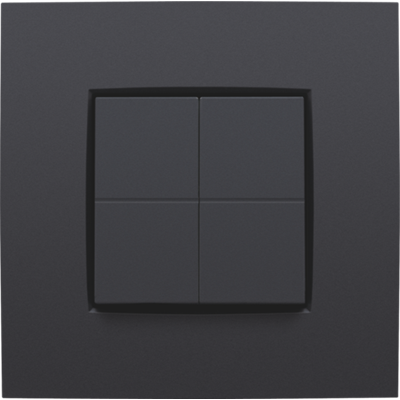
Niko dimmer switch for Hue system
With this wireless and battery-free dimmer switch, you can effortlessly operate Philips Hue lamps. Determine in the Philips Hue app what each button must do (switching on and off, dimming, activating scene settings). No wall breaking or cable installation is needed. The dimmer switch can be mounted on a European flush-mounting box, screwed onto a wall (screws not included) or glued to a flat surface with double-sided adhesive strips (included). Please note that Philips Hue Bridge v2 is required and not included.
Niko dimmer switch, KNX®
This wireless and battery-free dimmer switch in Niko design can operate as a switch, a dimmer, a roller shutter control or a scene selector in a KNX® system. This dimmer switch works together with the KNX® wireless media coupler (360-33001) who transmits the KNX® commands to the KNX® bus. This allows you to easily extend a KNX® system without breaking walls or installing extra cables. Configure the dimmer switch buttons with the ETS software that is available on the KNX® Association website together with the KNX® programming adapter (360-39001). The following communication objects can be linked to the buttons: single channel, dimming and shutter control. The supported functions are: on, off, toggle, up, down, darker, brighter, scene number, send value in percentage, in angle, in 2 bits, in 8 bits. Up to six button combinations can be configured. The dimmer switch can be mounted into a European flush-mounting box, screwed onto a wall (screws not included) or glued to a flat surface with double-sided adhesive tape (included).